Sunday, November 4, 2018

You Are a Mogul

Tech entrepreneur Tiffany Pham, a graduate of Yale and Harvard Business School, is one of the most interesting and important young women in social media. She wrote the code for Mogul, an information-sharing platform for women, and developed it as CEO into an influential media app.

Based largely on her personal journey, with an upbringing that ranged from cosmopolitan Paris to suburban Texas, Pham emphasizes the importance of adaptation and persistence in this guide to pursuing a career, a new business, a lifestyle, or a dream.

Directed primarily at young women, as is the Mogul site, this book zealously promotes a no-barriers vision of opportunities for women who are willing to work hard and professional achievement their priority. "You've got to kill it and over-deliver on every task you are given," she advises. "If you are only willing to work during your office hours, you miss out on opportunities for so many fulfilling endeavors, and the ability to start having an impact now."

This familiar career oriented approach won't work for everyone, but for those who it enables the impossible may be possible.  

How to Do the Impossible, Do It Yourself, and Do It Now
by Tiffany Pham
Simon & Schuster, 2018

Guidebooks and How-to Titles
list your book on Buy Direct Directory
Book List

Saturday, September 8, 2018

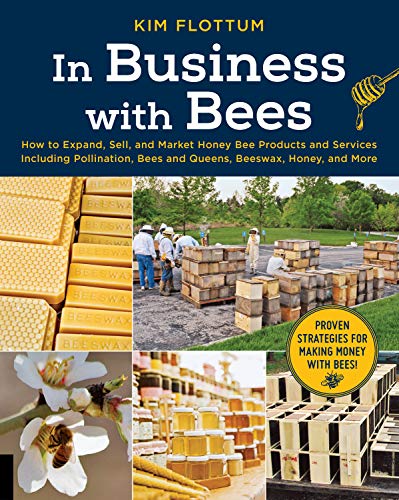
Selling More Than Honey

from In Business with Bees

"Consider that the equipment you are using is active for only a short time each year. The rest of the time it sits unused not earning you money, but still needing to be paid for. Can you remedy that? Yes. Provide services.

"You can essentially become a packer for other beekeepers who do not have the efficient machines or the extra time that you now do. They bring the honey, the bottles, and labels, and you fill and label for them...

"Another income generator you might consider is custom extracting. You use your equipment and their supers full of honey to put into their pails. This is especially nice for smaller operations that don't have the equipment you do, or for the hobbyists who don't have the time to devote."

How to Expand, Sell, and Market Honeybee Products and Services including Pollination, Bees and Queens, Beeswax, Honey and More
by Kim Flottum
Quarry Books, 2018

Animal Husbandry Books
Homegrown Honey Bees
Artwork: Honey Extractor


Sunday, November 29, 2015

Testing "How Asia Works"

Joe Studwell distills extensive research into the economics of nine countries — Japan, South Korea, Taiwan, Indonesia, Malaysia, Thailand, the Philippines, Vietnam, and China — into an accessible, readable narrative that debunks Western misconceptions, shows what really happened in Asia and why, and for once makes clear why some countries have boomed while others have languished.

For anyone interested in a region that will shape the future of the world, this is an important text.

by Joe Studwell
Grove Press, 2014
Outrider Reading Group
Guidebooks and How-to Titles
How To Do It Books

Tuesday, October 20, 2015

Review: The Art of Social Selling

The author of this book defines "social selling" by pointing out what it is not.

"Social selling is not like buying a list of leads and cold calling everyone on the list. It is not a disruptive process, where you merely spit out a series of marketing messages, lead-generation offers, or coupons and discounts. Nor is social selling the equivalent of lead scraping."

The basic principles of social selling are not new, although the technologies of LinkedIn, Facebook and Twitter differ from a beeper or a phone. They are based in the sales philosophy expressed by the imperative, “Don’t sell anything; make a friend instead.”

A digital marketing promoter and author of "Starting an Online Business All-in-One For Dummies," author Shannon Belew explains that effective social selling is nothing more than relationship building. "For most salespeople, this should come as good news. After all, the traditional sales process is just about that - relationships."

Whether you are on Google+ or Pinterest or Facebook, the principles are the same: seek out customers current and new, learn from what they are saying and engage them to build a sincere relationship. Every time you bring something of value to the conversation or service a need, you establish trust and build a reputation.

Finding and Engaging Customers on Twitter, Facebook, LinkedIn, and Other Social Networks
by Shannon Belew
AMACOM, 2014

Selling Points Archive
Book Stall
Open Market
Starting an Online Business All-in-One For Dummies

Friday, August 14, 2015

Why Go Google+ ?

Another advantage to having a Google+ profile is that you can connect your Google+ profile to your website and other social media profiles, increasing your exposure to prospective customers and helping your content be seen by a wider audience.
One way of increasing exposure is through the use of the "g+ share" button and the "+1" designation (the Google equivalent of a Like. For any content that you post, someone else can validate it as useful or liked simply by clicking the button to share it on their Google+ profile. When otherse see the content, they can click the "+1" icon to like and share the content from within Google+. 
As you might expect, the +1 is an increasingly important desiognation since it increases the visibility and reach of a piece of content. Of course, the use of Google+ may potentially help you show up in Google search engine results for related keyword searches. 
If you are a local business (as opposed to a national brand), getting the improved search result rankings may also make it easier for local prospective customers to find you or your business.
excerpted from:
Finding and Engaging Customers on Twitter, Facebook, LinkedIn, and Other Social Networks
by Shannon Belew
AMACOM , 2014
Guidebooks and How-to Titles
list your book on Buy Direct Directory
Outrider Reading Group

Sunday, November 30, 2014

Review: The Digital Economy

Long before there was Google or eBay or YouTube and while Mark Zuckerberg was still in grade school,  business writer Don Tapscott penned a best-selling book titled "The Digital Economy" predicting that the "Internet" many people took for a passing fad or geekish novelty was destined to become a major driving force in the world economy.

Twenty years later, we live in the world Tapscott prognosticated, where institutions like newspapers, the post office, libraries and even banks are having to question their role in society and the "mass media" of just a decade or so ago now seems improbably small and even irrelevant.

On the 20th anniversary of its publication, "The Digital Economy" has been republished in a new edition for which Tapscott has produced introductory essays for each of the book's twelve chapters, discussing what has changed since the first edition.

The Internet is becoming a new mode of production that changes the way we orchestrate capability in society to innovate, create goods and services, and even create public value," Tapscott notes in an essay preceeding the original Chapter 1.  "The most important assets are contained in the crania of knowledge workers. The most effective work systems are social and collaborative, and increasingly thoughtful people everywhere understand that an economy based on greed is not only unworkable, it threatens the planet."

While much of the book is centered on corporations and their responses to new economic paradigms, it also offers plenty of insights and suggestions for small businesses and independent producers and social agencies and consumers who stand to gain from or suffer under this evolving economic model.

"The social world is transforming the way we create wealth, work, learn, play, raise our children, and probably, the way we think," Tapscott points out. As with changes in the climate, the choice is either to adapt or be overwhelmed by this transformation.

Rethinking Promise and Peril in the Age of Networked Intelligence
by Don Tapscott
McGraw-Hill, 2014
Selling Points Archive
Book Stall
Outrider Reading Group
Book Search

Monday, October 27, 2014

Testing "The Digital Economy"


Two decades ago, The Digital Economy changed the way the world thought about the Web and Internet. While everyone else was in awe of “websites” and "dot coms," Don Tapscott was among the first people to argue that the Internet would fully transform the nature of business and government. It goes without saying that his predictions were spot on.

In this new edition of his classic work, the author provides topical updates with a sweeping new analysis of how the Internet has changed business and society in the last 20 years.

Rethinking Promise and Peril in the Age of Networked Intelligence
by Don Tapscott
McGraw-Hill, 2014
Selling Points
Outrider Reading Group
Guidebooks and How-to Titles

Tuesday, July 22, 2014

Testing "How to Make a Profit Creating & Selling Your Own Specialty Food Products in the USA"

Harvey P. Clark:
"Over the past several years of traveling all over the six New England states, including my home state of Massachusetts, I've frequently met many others selling their own specialty food products, and all seem to be asking each other the same questions. 
"It's been very common for others working at stores I sold to, or customers trying my products at store samplings, to ask how I got started doing this, and mentioning that they had an idea they'd like to bring to market too. 
"After digesting all this for quite a while, and finding that I've found a lot of the answers myself, through all these years of learning by trial and error, I decided it would be a very satisfying thing to try to make it easier for anyone else who wants to do this to find some of the answers, without needing to learn everything the hard way."
by Harvey P. Clark
CreateSpace Independent Publishing Platform, 2009
How To Do It Books
Specialty Foods
Guidebooks and How-to Titles
list your book on Buy Direct Directory

Monday, June 16, 2014

Testing "The Economy of You"

The "economy of you" is self-employment, side-gigs, moonlighting, freelancing, consulting, homesteading or whatever you want to call small-scale entrepreneuring. It is an economy driven by a desire for autonomy and self-determination more than profit, and a response to the insecurity that pervades today's workplace.

Driven by rapacious corporations and a breakdown in traditional business models, the alternative lifestyle of working for yourself and starting your own business has become mainstream and, for many, the most promising opportunity.

This book is based on dozens of interviews with and profiles of entrepreneurs who share the stories of their enterprises. The author, a magazine editor and blogger, groups their experiences in chapters on planning, financing, networking, and surviving this new economy. An appendix lists 50 side-gigs to consider, from disc jockey and florist to marketing consultant and yoga teacher.

Many of the "side-giggers" interviewed said that running a side-gig felt like an obvious and necessary choice, just as getting a nine-to-five job for life might have to their grandfathers. But if the night job becomes as necessary as the day job, and neither is sufficient by itself, then the "economy of you" is an economy of 80-hour work weeks and burned out prospects.

Discover Your Inner Entrepreneur and Recession-Proof Your Life
by Kimberly Palmer
AMACOM, 2014

The Economy of You
Guidebooks and How-to Titles
list your book on Buy Direct Directory
Outrider Reading Group

Tuesday, May 13, 2014

Testing "How an Economy Grows and Why It Crashes"

In this updated edition of How an Economy Grows and Why It Doesn't by their father, Irwin Schiff, brothers Peter D. Schiff and Andrew J. Schiff weave a fable that untangles many of the fallacies preventing people from really understanding what drives an economy.

With the help of colorful cartoon illustrations, lively humor, and deceptively simple storytelling, the Schiff's bring the complex subjects of inflation, monetary policy, recession, and other important topics in economics down to Earth.

by Peter D. Schiff and Andrew J. Schiff
Wiley, 2014

How an Economy Grows and Why It Doesn't
Guidebooks and How-to Titles
list your book on Buy Direct Directory
Outrider Reading Group

Wednesday, April 23, 2014

Online Retailers Get an Edge by Not Collecting Sales Tax

Two independent studies of online sales using two very different approaches reached the same conclusion: some online retailers have an advantage over traditional brick-and-mortar stores.

The studies find evidence from investors, analysts and consumers themselves that suggest online stores have a competitive edge when they don’t have to collect sales tax from shoppers.

Both studies were conducted by researchers at the Fisher College of Business at The Ohio State University and their colleagues.

One study found that sales fell 9.5 percent at Amazon.com in five states when the online retailer began collecting taxes on online purchases.

The other study found that the stock prices of online retailers dropped when news broke about possible legislation that would require them to collect sales tax.

Overall, the two studies show that consumers spend less at online retailers when they have to pay sales tax – and investors are quite aware of the threat these firms face from new tax-collection laws.

Sources: Fisher College of Business
The Ohio State University  University Communications

Artwork: Artisoo Cash Register by Amadeo de Souza-Cardoso
Selling Points Archive
Advertising on Selling Points
Book Stall
Book Store


Tuesday, March 11, 2014

Testing "The Art of Social Selling"

Social media platforms such as Facebook, Twitter, LinkedIn, and Pinterest are changing the way consumers make purchasing decisions ...and tapping into these online communities has become a necessary part of any integrated sales strategy.

Citing enlightening research and real-world examples, this practical guide presents readers with a detailed methodology for growing sales and expanding their customer base using social media.

Finding and Engaging Customers on Twitter, Facebook, LinkedIn, and Other Social Networks
by Shannon Belew
AMACOM , 2014

Outrider Reading Group
Book Search
Guidebooks and Hot-To Titles
Selling Points Archive

Tuesday, December 3, 2013

Finding Your Voice on Facebook

"The key to successfully marketing your business on Facebook is finding an authentic voice that connects with and engages your desired audience," suggests John Wayne Zimmerman in The Complete Idiot's Guide to Facebook Marketing.

Zimmerman devotes a chapter of his to "The Voice of Your Business" that suggests choosing a celebrity whose persona reflects the way you want your business to be perceived. Mimic the language and style of this "celebrity spokesperson" in your Facebook posts, he advises, and try to be consistent. If more than one person is posting, make sure they also use this "brand."

As for the content of your posts, Zimmerman says it should always be what your target market wants. "If you own a landscape business, focus on offering tips on how to prepare the lawn for winter, how to get rid of grubs, and when to plant bulbs in your garden."

by John Wayne Zimmerman
ALPHA, 2012
Outrider Reading Group
Guidebooks and Hot-To Titles
Selling Points Archive
Advertising on Selling Points

Thursday, May 23, 2013

Time for a Mobile Marketing Strategy

Many analysts predict mobile browsing on the web is going to surpass desktop browsing by 2015, or soon thereafter. This is indicative of a fundamental shift in Internet users' browsing habits and choice of devices. E-marketers of all stripes are going to have to develop or incorporate a mobile marketing strategy into their business plans.

Practical Plans to Get Your Business Mobile in Just a Few Days for Just a Few Bucks
by Deltina Hay
Selling Points Archive
Mobilizing Web Sites: Strategies for Mobile Web Implementation
Open Market
Outlet for Phones and Accessories

Monday, February 25, 2013

Is Organic a Better Meat?


Whether or not organic meat is actually more nutritious or safer than non-organic, the idea has cogency among consumers and is a principal driver for the organic market.

Authors of the paper on "Organic Meat Marketing" in Organic Meat Production and Processing note that "there is no evidence that organic food is healthier or more nutritious. Consumers are often not aware that the organic standards are only based on the production and processing of the product and not on the final quality of the product."

They concede, however, that a majority of consumers have concerns about chemicals like hormones and herbicides in their food and try to avoid them as much as possible.

"These worries have increased because of the negative publicity about genetically modified (GM) crops, which are sold and fed to livestock, and... food scares such as bovine spongiform encephalopathy, foot and mouth disease, Salmonella, and Escherichia coli outbreaks."


edited by Steven C. Ricke, et al.


continued in The Book Stall


Organics
Meats
Advertising on Selling Points


Sunday, February 17, 2013

Contagious


Word-of-mouth often leads to popularity, or notoriety. It is much more effective than any form of traditional advertising and it seriously impacts the products people buy, the way they behave, and what they discuss.

So, how do you get it? What makes people talk about certain subjects rather than others? What makes some online content go viral? According to marketing professor Jonah Berger, the answer came be found in the psychology of social transmission.

Berger and his colleagues in the Wharton School at the University of Pennsylvania studied hundreds of products, analyzed thousands of news articles, and tracked millions of purchases in an effort to understand why people talk about and share certain things more than others with the objective of helping marketers By applying this knowledge to their own products and ideas, marketers craft "contagious" content that is more likely to spread.

"We noticed that the same six 'ingredients' or principles were often at work," Berger explains. "Six key STEPPS, as I call them, that cause things to be talked about, shared, and imitated."

Berger's six STEPPS to contagiousness are delineated as Social Currency, Triggers, Emotion, Public, Practical Value, and Stories. Each chapter of his book, Contagious  focuses on one of these principles with research and examples showing how individuals, companies and organizations have applied them to help popularize their products and ideas.

Berger's book has some clear and important implications for anyone selling something, whether it is broccoli at a farmers market or an e-book online. By understanding why people talk about and share things, you can make your own product more contagious.


Why Things Catch On
by Jonah Berger
Simon & Schuster, 2013


Selling Points Archive
Advertising on Selling Points
Buy Direct Directory
Open Market